The Stages of Melanoma
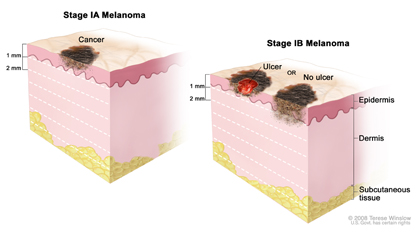
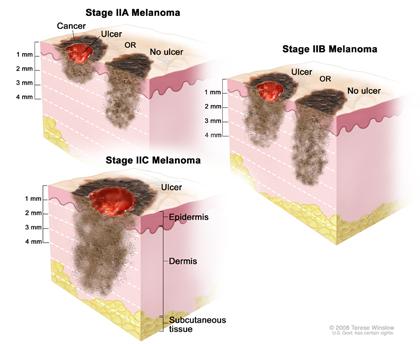
Stages I and II: The tumor is apparently confined to the site where it started and is up to 1.5 millimeters thick; there is no evidence of nearby skin or lymph node involvement or of distant metastasis. The five-year survival rate depends on the Melanoma's thickness and varies from about 95 percent of the people who have stage IA lesions (a millimeter or less in thickness, not ulcerated, and not level II or III) to under 50 percent for patients with stage IIC lesions (thicker than 4 millimeters and ulcerated).
Stage II: The primary tumor is more than 1.5 millimeters thick; there is no evidence of spread. The five-year survival rate is about 80 percent.
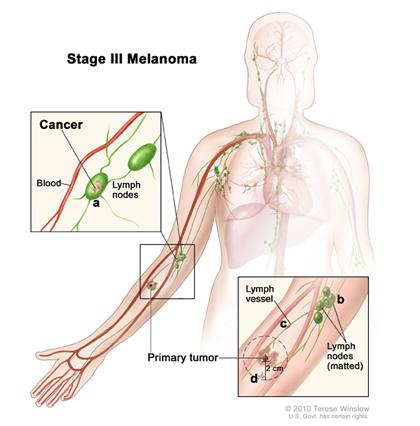
Stage III: Melanoma has spread beyond the place where it started and into nearby skin or, more commonly, into the lymph nodes (glands) near the primary tumor. The five-year survival rate depends on how many nodes have been affected and whether they have within them only microscopic amounts of tumor or enough to make the glands big enough to feel. For patients with only microscopic amounts, the survival rate is as high as 70 percent, while for those with easy to feel nodes, the survival rate is as low as 15 percent.
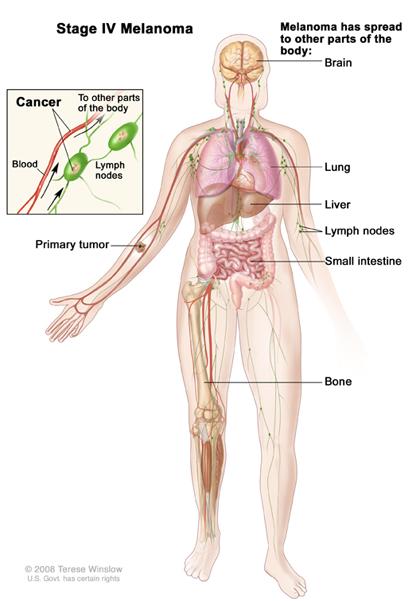
Stage IV: Colonies of Melanoma cells are evident beyond the regional nodes (in distant skin or nodes or in the organs of the body). The five-year survival rate is about 10 percent.