Prevention
The lifetime risk of getting melanoma was one in 250 in 1980; in the year 2004 the risk of developing invasive melanoma was estimated to be one in 55. Melanoma has a deadly reputation and in the 1930’s, when the mortality rate stood at 75 percent, it was just that---deadly. However, the current death rate from Melanoma has dropped to under 15 percent, therefore showing proof that the early identification of Melanoma allows for a remarkable recovery rate.
Fortunately, Melanoma is visible to the naked eye. It is usually pigmented and begins in the top layers of the skin. These features make it easy to spot and treat if caught early, a clear difference from other deadly cancers. Unfortunately, many cases of Melanoma go unnoticed until the later stages, when they are less likely to be curable. Doctors are still a long way away from being able to treat advanced-stage melanoma with specifically targeted new drugs. Along with prevention, early detection is still the best line of defense against Melanoma.
The Steps of Melanoma
The earliest step of Melanoma is when it is confined in its situ, Latin for “place of origin”: the epidermis and the top layer of the skin. Here Melanoma is called the radial growth phase because early Melanoma appears as an irregular circular blotch on the skin that gradually expands along the radius of an imperfect circle. The next step is called the invasive radical growth phase, called invasive because the Melanoma extends shallowly into the dermis, the second layer of the skin, from the epidermis. Melanomas treated at either of these steps are almost 100 percent curable. However, the next step is the vertical growth phase, in which part of the Melanoma starts to become dome shaped as it grows in and through the rest of the dermis. After this, the Melanoma enters the bloodstream and can appear virtually anywhere in the body. At this stage, though it is still possible to be cured, the mortality rate is high. Therefore, the earlier Melanoma is discovered and treated, the higher chances there are of recovery. | 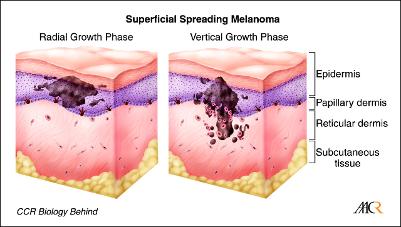 |
How do I Detect Early Melanoma?
Regular skin examining is crucial to finding early Melanoma at its most curable stage, so you should set up a schedule of self-examination. This examination is extremely important as a supplement to professional follow-up. Patients, if educated properly, can spot a significant legion just as quickly as a physician can.
ABCD's
Normal moles are small, flat or dome-shaped skin blemishes or growths, whereas dysplastic nevi (scientific term for moles) are larger, unusual-looking moles that can be warning signs for an increased risk of getting malignant Melanoma. To help you recognize the look of early Melanoma, follow the “ABCD’s”.
    | A for Asymmetry B for Border Irregularity The edges are notched, uneven, or blurred.
C for Color D for Diameter |
